 SERENALIN.DESIGN
0→1 · Groundup Exploration
Designing the Next Handheld POS Experience
I led the design direction for the initial Toast Go Mini phase: a touch-first food-truck ordering and payment MVP. I explored where voice could speed up the flow, compared screen sizes, and tested early POS design system concepts with the POS team.
- Role
- Lead Designer
- Timeline
- In progress
- Team
- POS + Handheld
- Platforms
- Toast Go, POS
- Scope
- New workflow, voice assist, POS UI & design system
- Status
- MVP prototype
Challenge
Food-truck operators need a compact way to manage a queue, take orders, and complete payment in a tight service space. Touch stays the primary path; voice can speed up selected steps.
The Next Gen handheld effort also looks toward very small and mid-sized businesses and global markets. The MVP starts with food-truck order taking; fit for kiosks and other business types remains to be tested.
Insights
Interviews showed that comfort with voice varies across business types. Voice is an opportunity to test, not a safe default. A touch-led flow gives the MVP a familiar, complete path while we learn where voice helps.
Solution
I led the initial design direction around a food-truck MVP: smaller menus and a focused ordering-and-payment workflow. I kept touch primary, explored voice as an assist, and tested screen sizes and early POS system concepts.
Impact
The initial phase established a focused workflow and concepts across screen sizes and POS patterns, giving the team concrete material to discuss simplification across user segments. Next, validate with food-truck operators and compare patterns with kiosk and other business users.
Framing the product decision
This was not a screen redesign. It was a decision about what the next handheld should be.
I framed two decisions for the Next Gen handheld: how voice and touch should divide order taking, and which customer segment should define the first MVP. The concepts make both tradeoffs concrete for product, hardware, and engineering.
Touch-first, voice-assisted
Keep the touch screen as the main path for menu selection, order review, and payment. Use voice to speed up supported steps without taking control away from the operator.
- Touch carries the full workflow
- Voice assists selected tasks
- Operators can review and correct before sending
Food-truck operator
Start with small food-truck teams taking and adjusting orders in a compact, high-turn service environment.
- Compact footprint, limited counter space
- One person may shift between roles
- Validate before broader SMB expansion
Grounding the direction
Different user types have different impressions of voice.
We conducted interviews across business types to understand how teams respond to voice during service. Reactions varied: some saw it as a useful shortcut, while others worried a recognition error could interrupt service and make a busy moment worse. Those differences informed a touch-first food-truck MVP.
Design focus: Help food-truck operators move from order capture to payment in a compact workflow, with clear review and touch controls at every step.
Voice reactions vary by business
Different service contexts shape whether voice feels useful, comfortable, or disruptive.
Food trucks offer a simpler first workflow
Smaller menus and a focused order-and-payment flow make the MVP easier to scope and test.
An opportunity to better serve the segment
Food trucks are a business type Toast can serve better; validate the opportunity with operators.
Defining the interaction system
Touch leads the flow. Voice assists selected steps.
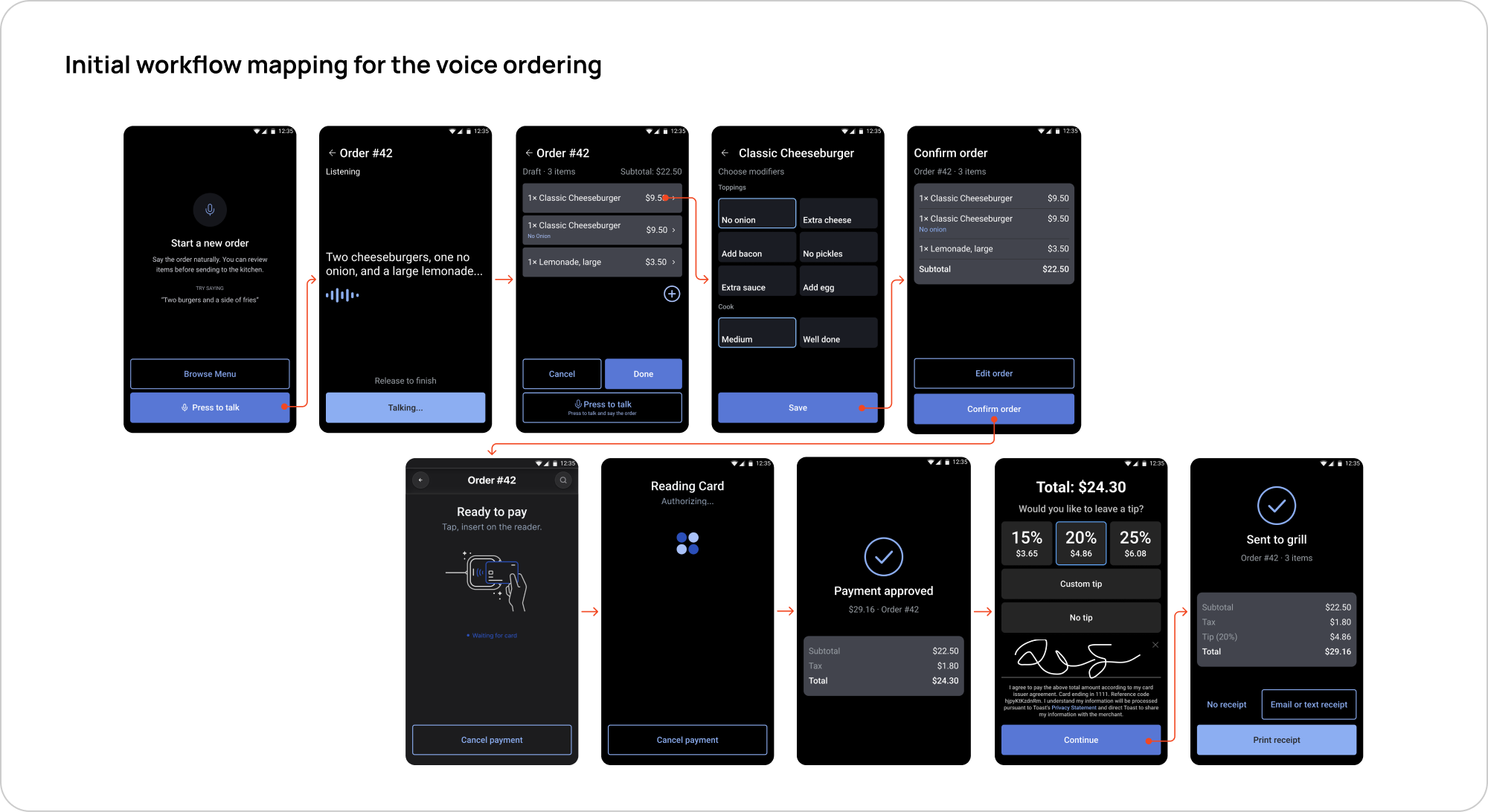
I explored touch-first layouts across screen sizes, with voice as a secondary input for order capture. The work also tests POS design system concepts for a simpler workflow.
Keep the active order in focus
Prioritize menu items, modifiers, order total, and payment action in a compact touch interface.
Keep voice status clear and secondary
Show ready or listening states without taking focus from the menu, active order, and touch controls.
Make review and correction easy
Operators should be able to review and edit any item by touch before sending or taking payment.
Screen sizes exploration
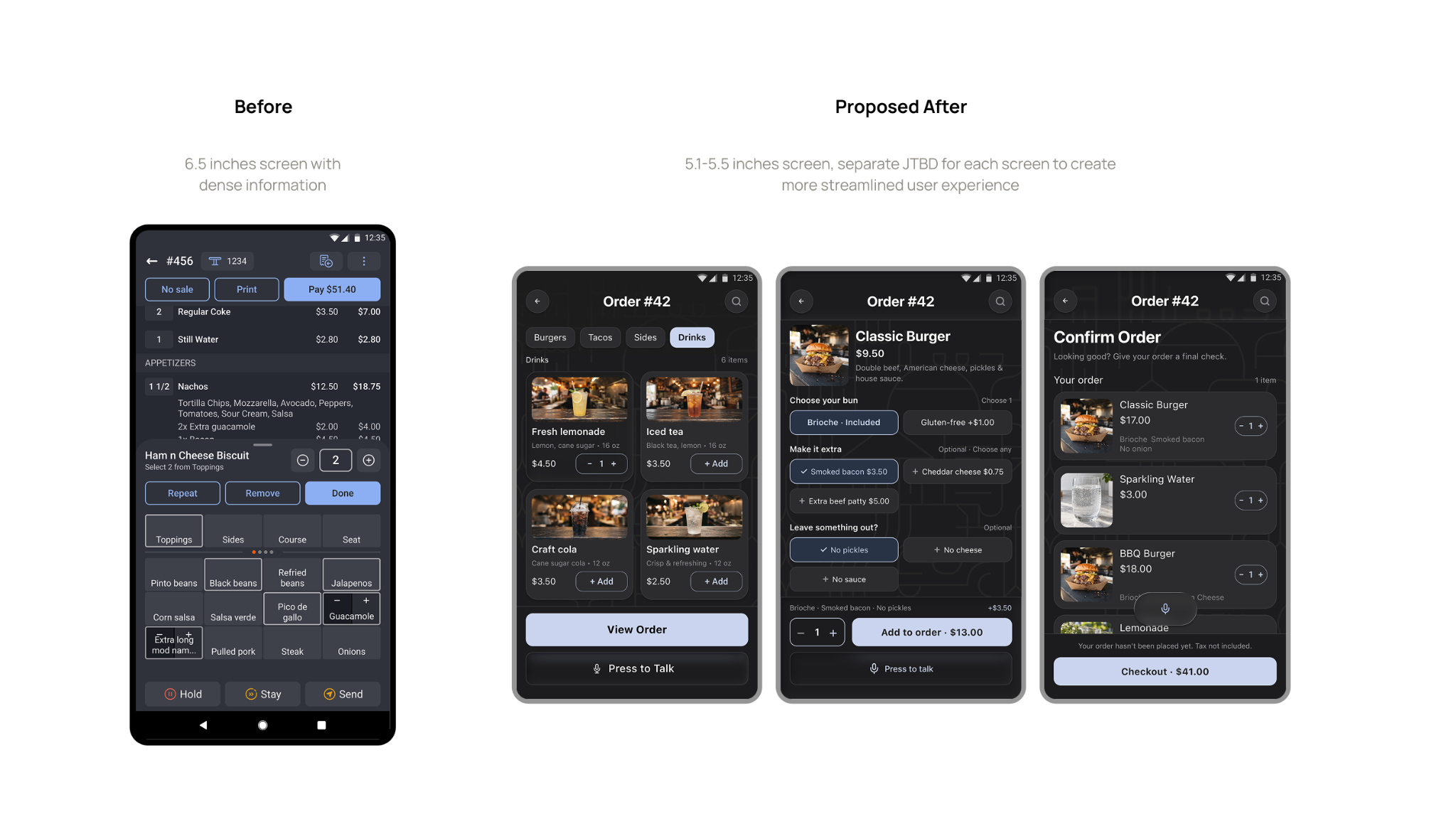
Explore the workflow across different screen proportions.
I compared different screen proportions and POS design system concepts through ordering and payment. These explorations help the team discuss which patterns can simplify workflows across segments.
User interface design system components
Test reusable POS patterns through a focused ordering flow.
I explored how a new POS design system could make the experience feel more welcoming and approachable, using food and menu-item imagery to bring warmth to browsing. I also tested reusable interface patterns across ordering, voice input, review, and payment.
What remains open
Use the food-truck MVP to learn what should scale next.
The first concepts make the core ordering and payment workflow tangible. These questions will shape the next round of prototyping and validation.
Does the touch-led workflow fit food-truck service, and which patterns transfer to kiosks or other small businesses?
Which ordering moments become faster or easier with voice, and where does it add friction?
Can operators confidently review, correct, send orders, and complete payment in a compact interface?
Which components and screen-size patterns can support a wider set of devices and user segments?
Screen size usability testing
Test essential screens across device sizes.
I explored how core screens—including PIN entry, menu browsing, and voice ordering—work across screen sizes, checking that each remains clear and easy to use.
0→1
Touch-first food-truck MVP
Voice + touch
Touch leads; voice assists in the MVP food-truck use case to validate the concept.
Design System
Explore reusable POS patterns while refining the design system.
Next project
AI Coach for Employee Onboarding
Turning fragmented R&D onboarding into a role-based platform that helps new hires move through team-dependent learning, gives managers visibility into progress, and helps admins manage assignments and AI Coach feedback. Building on an initial structure created in Claude by the R&D Onboarding Manager, I led UX across the New Hire, Manager, and Admin experiences and implemented Toast’s Buffet Design System.