 SERENALIN.DESIGN
03 · AI-Native R&D Onboarding
AI Coach for Employee Onboarding
Turning fragmented onboarding knowledge into a clear, guided experience for new R&D employees and the managers supporting them.
Building on an initial structure created in Claude by the R&D Onboarding Manager, I led the AI conversation and platform UX across the New Hire and Manager experiences, and implemented Toast’s Buffet Design System within the product.
- Role
- Lead Designer
- Timeline
- 3 Months
- Team
- R&D Onboarding
- Platforms
- AI, Web App
- Scope
- AI Conversation UX, Experience Architecture, Interaction Design, Buffet Design System
- Status
- Testing with Q4 New hires
Challenge
New hires struggled to find timely guidance across a growing knowledge base, while managers had to track progress and follow up without getting lost in the same document-heavy ecosystem.
Insights
AI should not replace a document desert with a wall of text. Answers needed to be glance-able, contextual, and organized around the next action.
Solution
The R&D Onboarding Manager created the original structure in Claude. As Lead Designer, I built on that foundation and led the AI conversation UX, experience architecture, interaction design, and Buffet implementation. The experience has two designed areas—New Hire and Manager—while the Admin experience remains under development.
Impact
The experience is scheduled to enter new-hire testing in Q4 2026, creating a grounded path for validation and refinement before broader rollout.
Challenge
New hires were left in the weeds of a growing knowledge ecosystem
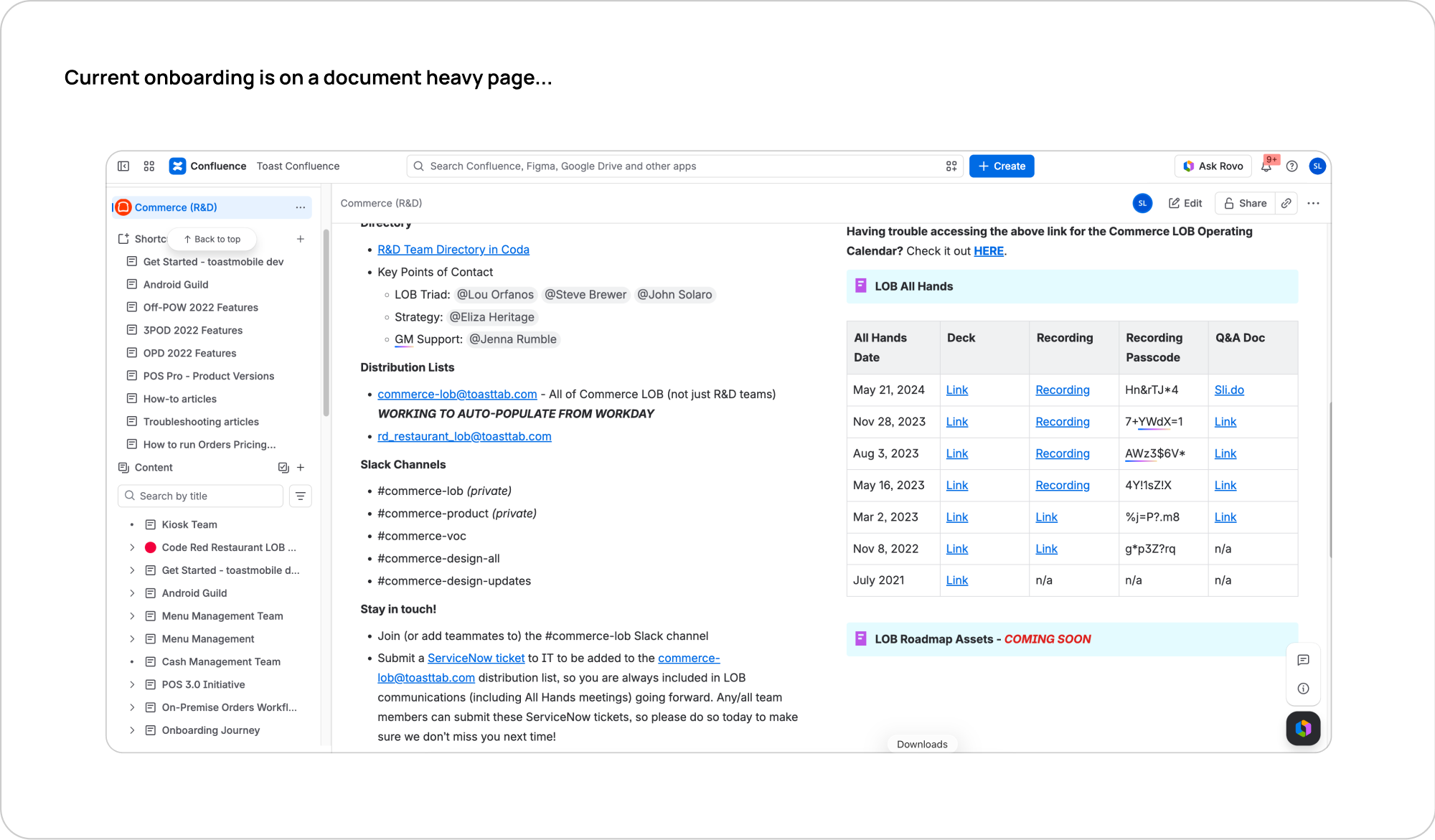
Toast R&D onboarding included a huge amount of knowledge distributed across Confluence, team documentation, tools, and different onboarding platforms. In their first weeks, new hires often had to work out which source was current, what applied to their role, and what to do next.
As the Confluence knowledge base grew, finding an answer quickly became harder. The experience depended too heavily on each new hire knowing what to search for before they had enough context to ask the right question.
Insight
The problem was navigation, not information
The organization already had rich onboarding content. What new hires lacked was a clear path through it: what matters now, what can wait, where an answer lives, and who can help when documentation is not enough.
This reframed the opportunity from building another knowledge destination to creating a contextual onboarding layer that connects people to the right next step.
Design Leadership
I turned an AI-generated starting point into a coherent product experience
The R&D Onboarding Manager brought the domain expertise and created the original product structure using Claude. I built on that foundation as Lead Designer, translating the initial structure into a clear experience architecture and leading the UX direction across the product.
My ownership included the AI conversation experience, New Hire and Manager journeys, interaction patterns, glance-able information design, design iteration, and Buffet implementation.
Product Structure
Two connected experiences support the people on both sides of onboarding
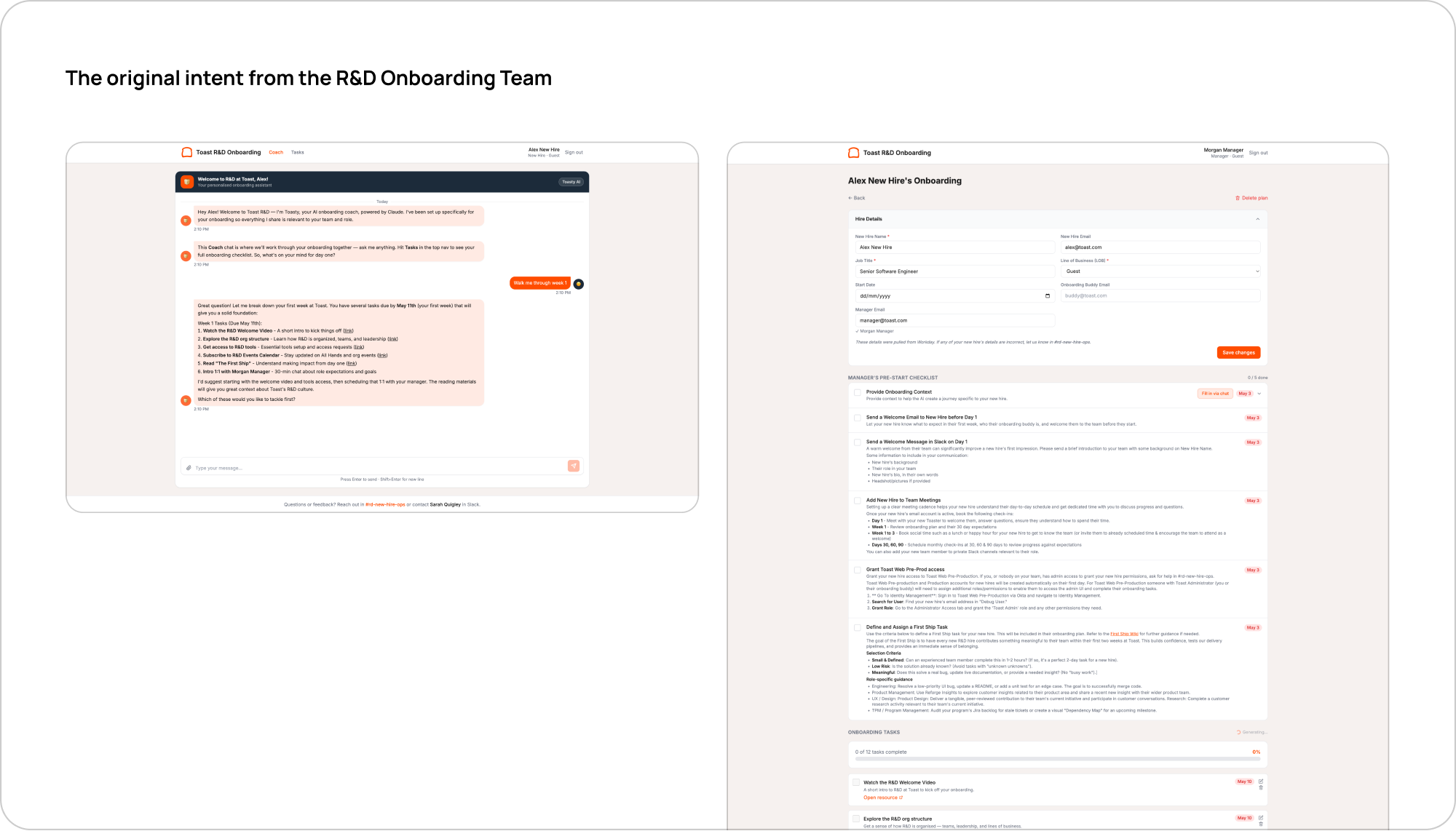
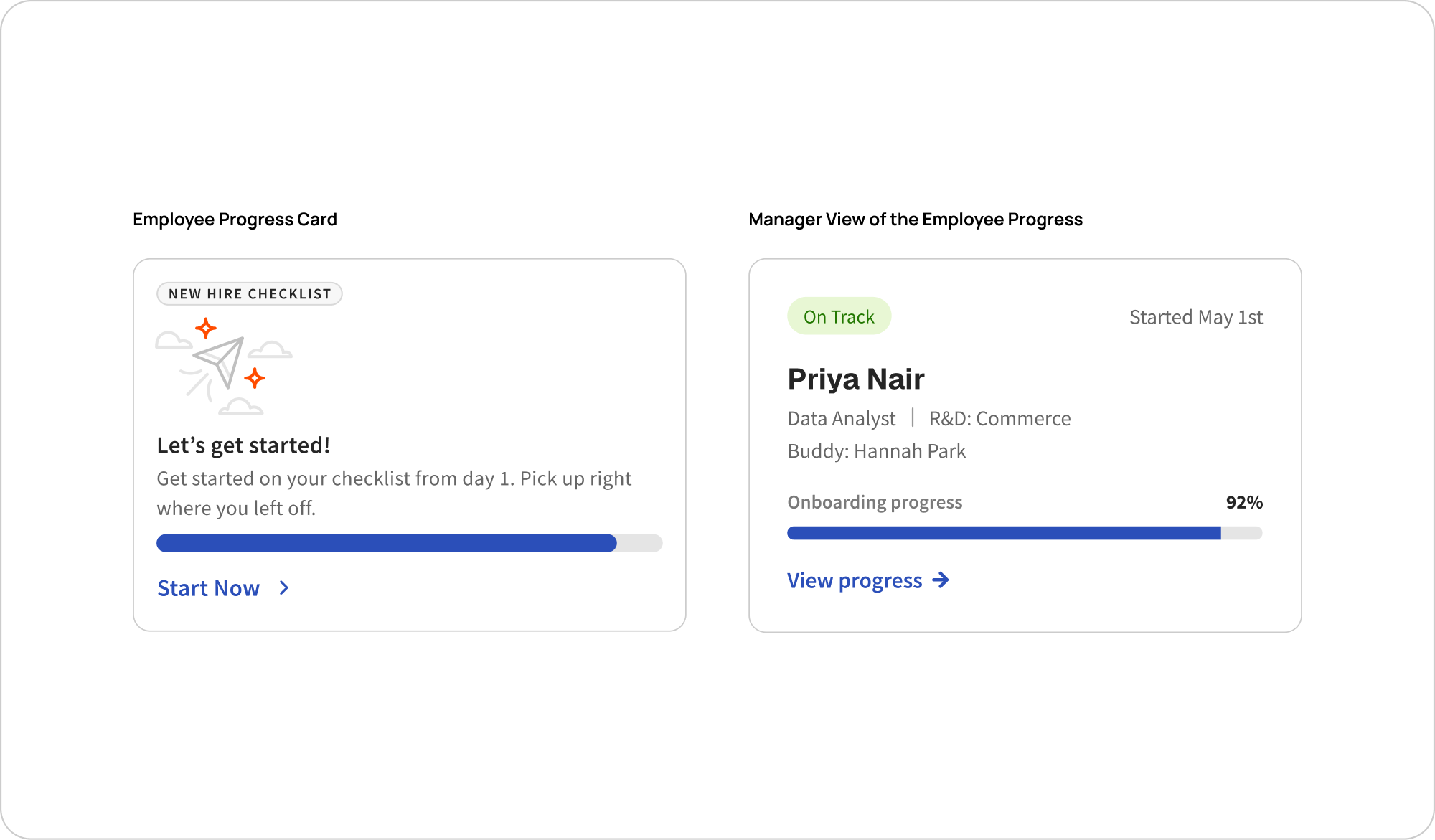
I designed two primary areas of the product. The New Hire experience helps employees understand priorities, ask questions, find knowledge, and move through their first weeks. The Manager experience gives managers visibility into progress and creates timely opportunities to support each person.
The Admin experience is still under development, so this case study focuses on the two areas I have designed and the relationship between them.
AI Conversation UX
Make every AI response glanceable before asking someone to read deeply
A conversational interface can easily reproduce the same problem as a dense knowledge base by returning a long block of text. I proposed a response structure that lets new hires understand the answer at a glance before deciding whether they need more detail.
Responses prioritize the direct answer, organize supporting information into clear sections, and surface the most relevant next actions. This turns the conversation from passive reading into guided progress.
Manager Experience
Help managers stay considerate and consistent without losing the thread
Managers needed to understand how new hires were progressing, remember when to follow up, and offer support at the right moment. Existing information was scattered across documents and informal check-ins, making it easy to lose track.
I designed the Manager experience to make progress visible and follow-up manageable without creating another administrative burden. The goal is a smoother workflow for managers and a more thoughtful, connected experience for every new hire.
Design System
I led the implementation of Toast’s Buffet Design System within the onboarding platform
Rather than creating a separate visual language for onboarding, I applied Toast’s existing Buffet Design System across the platform. I defined how its components and patterns should support onboarding-specific needs such as content hierarchy, task guidance, knowledge retrieval, progress, and contextual support.
This implementation keeps the experience consistent with the broader Toast product ecosystem as new roles, teams, tasks, and knowledge sources are added. The onboarding platform feels like part of Toast, not a disconnected internal tool.
Impact
Moving into new-hire testing in Q4 2026
After three months of definition, system design, and iteration, the next milestone is testing the New Hire experience with incoming R&D employees. The study will focus on whether people can scan AI responses, understand what to do next, locate information with less effort, and build confidence during their first weeks.
The Manager experience will continue to evolve alongside those findings, while the Admin page remains under development. Because testing has not started yet, this case study presents the product direction and design foundation—not unvalidated outcome claims.
Next project
Exploring Voice AI for Restaurant Operations
An early-stage exploration into where voice AI may create value in restaurant workflows—and what physical infrastructure would be needed to make those ideas testable.